


Technology
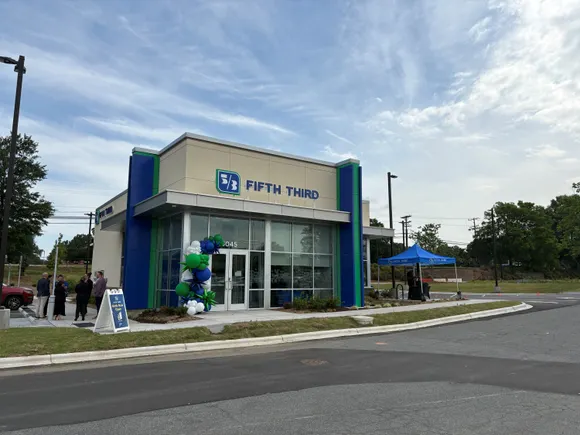
During Fifth Third's Q3 earnings call, CEO Tim Spence and CFO Bryan Preston discussed the threat of AI-driven cash optimization, particularly following Meta's launch of AI assistant Muse. Spence argued that banks with physical distribution and added value are less at risk than online-only lenders, while Preston said concerns are 'likely overblown' given Fifth Third's $3,000 median checking balance and operational commercial deposits. The bank doesn't currently allow AI agents to initiate transactions, and Preston emphasized the need for accountability questions to be settled first. Spence highlighted the opportunity for incumbents to integrate valuable services into their apps, leveraging bank-grade security and data separation. Fifth Third reported 3% sequential growth in average core deposits to $236 billion, with deposit costs rising slightly.

Huntington Bank has launched 1866 Studio, an AI-powered platform designed to help small businesses manage and grow. Named after the bank's founding year, the platform uses Google Gemini and eight trained AI agents to simplify workflows, provide business launch support, marketing strategy, and financing guidance. Available to all small-business owners, not just Huntington customers, it aims to be a customer acquisition tool and will evolve to support the full business lifecycle.

ScribeUp, a recurring bill management service for financial institutions, closed a $13 million Series A round led by Curql Collective, with Mucker Capital and Service Ventures participating. The funding includes $10 million in equity and a $3 million venture debt facility. ScribeUp provides infrastructure for the recurring economy, enabling over 60 financial institutions to let customers identify, manage, and cancel recurring payments within their banking apps. Using agentic AI, it can track some 200,000 unique subscription billers and proactively alert users to upcoming bills that may cause overdrafts. The company was founded in 2020 by Jordan Mackler and Yohei Oka, inspired by Oka's experience of forgetting subscriptions and incurring $350 in fees. The new funding will support hiring, technology, and go-to-market strategy.

Banks increasingly rely on interconnected systems like building controllers, surveillance cameras, and vendor-managed appliances, creating ownership gaps that complicate cybersecurity. A vulnerability in a branch controller may be known but not resolvable because security, facilities, IT, and external contractors each own only part of the problem. Regulations like NYDFS 23 NYCRR Part 500 require asset inventory policies that address ownership, location, and support expiration, highlighting the need to connect asset visibility with accountability. Continuous, intelligence-driven assessment and passive discovery can identify specialized equipment and provide context for prioritization. However, findings must reach the teams responsible for remediation. The combination of Armis Centrix™ and ServiceNow workflows helps route findings, coordinate remediation, and maintain records of decisions. A case study shows a global financial services organization discovered three to four times as many assets as its CMDB reflected, improving vulnerability prioritization. Closing the gap between knowing and doing requires connecting exposures to accountable teams, enabling defensible risk-reduction decisions.

C&R Software draws a parallel between banks' fragmented digital communications adoption in the early 2010s and current AI procurement, cautioning that point solutions lead to agent sprawl, disconnected systems and technical debt. Citing an MIT study that 95% of organizations see no measurable return on generative AI investments, the article argues banks should build AI-native capability—shared decisioning engines, data models and governance layers—rather than bolting on narrow tools. It highlights collections as a proving ground and notes that analysts recommend defining domains of authority, deference protocols and resolution layers for AI agents. C&R Software positions its Debt Manager solution as AI native.

AI is moving from pilots into core financial operations such as fraud detection, trading, and underwriting, forcing institutions to reconsider where AI workloads should run. Cloud-only strategies face new challenges around latency, power, cooling, governance, and data sovereignty. Many organizations are adopting a deliberate infrastructure strategy that evaluates cloud, colocation, modernized data centers, and hybrid models based on business priorities, workload requirements, and risk tolerance. Schneider Electric research highlights factors including data sovereignty, latency, time-to-market, scalability, staffing expertise, cash flow preferences, and total cost of ownership. Success will depend on aligning infrastructure decisions with business outcomes while preserving resiliency, security, and operational control.

Financial services AI is moving from back office to front lines, with 32% to 39% of work in capital markets, insurance, and banking poised for full automation. But legacy networks cannot handle the massive, bursty traffic and strict latency requirements of AI workloads. HPE's AI-native, self-driving routing solutions offer uncompromising performance for mixed workloads, experience-first Agentic AIOps, autonomous zero-trust security, and radical OpEx and sustainability gains, enabling financial institutions to lead in the AI era.

During Q3 earnings calls, top bank executives addressed agentic AI. JPMorgan CEO Jamie Dimon said the bank is not for or against agents but will block outside agents due to risk, while using model routing to cut costs. Wells Fargo CEO Charlie Scharf said the bank is excited but disciplined about risk. Citi CEO Jane Fraser reported 30-40% faster product launches and 30% lower tech vendor spend year-over-year, with 14,000 engineers using the Devin coding tool. Morgan Stanley CEO Ted Pick called AI's power incontrovertible but stressed trust, and CFO Sharon Yeshaya said AI is changing team functions. Goldman Sachs CEO David Solomon said some AI aspects are unknown but innovation must continue with responsibility. Bank of America CEO Brian Moynihan said AI drives franchise growth and automation reduces hiring needs.

JPMorgan Chase livestreamed a fraud-focused panel to about 700 branches on Wednesday. The panel included Pat Opet, the bank's information security chief; Michelle Singletary, a Washington Post columnist; and Brett Leatherman, assistant director of the FBI's cyber division. They discussed how AI-enabled impersonation and money movement scams can be spotted and how individuals can strengthen their cyber defenses. Darius Kingsley, Chase's head of consumer fraud and scam prevention, moderated the panel from the bank's mid-Atlantic regional headquarters in Washington, D.C. Kingsley said scams are becoming more sophisticated with open-source AI models, and that younger people are increasingly falling victim. Impostor scams cost reported victims $3.5 billion in 2025, according to the FTC, while Gallup estimated the figure at $68 billion. Kingsley emphasized that fraud starts upstream and requires cross-industry collaboration.

During JPMorgan's third-quarter earnings call, CEO Jamie Dimon warned customers that using AI agents to access bank accounts entails a liability transfer and risks from rogue agents. He said the bank is building tools to protect customers and will not allow just any outside agent inside the company. CFO Jeremy Barnum noted JPMorgan's AI-powered Smart Cash tool is in pilot and discussed AI spending and productivity benefits, which are not yet visible in quarterly earnings.