


Fintech

Fiserv has launched its stablecoin system, debuting with the Roughrider Coin backed by the Bank of North Dakota. The platform, developed with VersaBank, Fireblocks, and Solana, aims to enable efficient money movement for roughly 90 financial institutions. The launch comes as Fiserv faces pressure from activist investor Jana Partners and questions about its own FIUSD stablecoin.

Mercury Bank CEO Jon Auxier said at the Federal Reserve Bank of Philadelphia's annual fintech conference that pursuing a bank charter must be a fintech's top priority to succeed. Mercury applied for a national bank charter in December and aims to launch Mercury Bank by late 2027. Auxier, who helped lead SoFi's charter implementation, emphasized that charter preparation affects every function. SoFi Bank EVP Eric Schuppenhauer and Square Financial Services CEO Richard Rosenthal also shared insights on mindset, hiring, and the benefits of strong supervision.
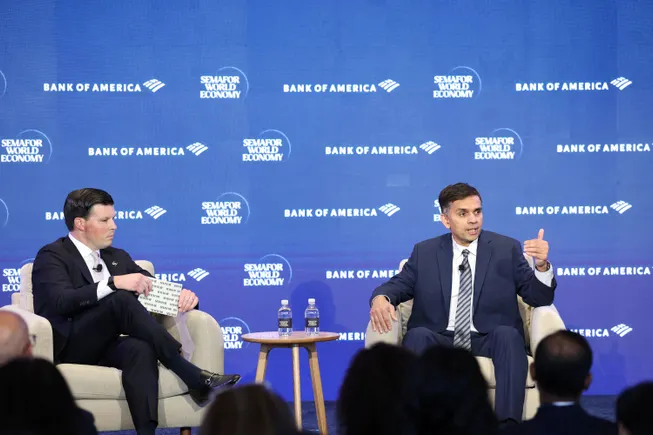
Bank of America's Technology Innovation Summit, now in its 15th year, brings together about 500 tech company founders and investors with bank leaders. According to Hari Gopalkrishnan, the bank's chief technology and information officer, the event not only helps scout partners but can also lead the bank to shift gears on tech initiatives. About one-fifth of the 7,000 participating companies have become vendors. The summit provides insights into industry trends, helps startups understand enterprise-scale implementation, and informs BofA's strategy, with AI and payments as key focuses.

Circle CFO Jeremy Fox-Geen will step down in December after five years as finance chief, the company announced Friday. Fox-Geen helped lead Circle through its June 2025 IPO, which raised $1.05 billion at an approximately $8 billion valuation. He will remain CFO until December 31 or the appointment of a successor, and will receive a $1.05 million cash payment and accelerated vesting. Circle also announced a $100 million equity investment from Binance and the immediate resignation of co-founder P. Sean Neville from its board for personal reasons. TD Cowen analysts expect an orderly transition with no internal disruption.

Valley National Bancorp, based in Morristown, New Jersey, has agreed to acquire Bluevine, a Jersey City-based small-business banking fintech, for $340 million in cash and stock. The deal, projected to close in early 2027, will bring Valley about $2.1 billion in deposits and expand its small-business customer base by 20 times. Bluevine, founded in 2013, has about 175,000 active small-business customers and provides digital banking, payments, lending, and financial management solutions. The acquisition also includes Bluevine's technology and AI capabilities, with about 180 R&D employees joining Valley. Bluevine CEO Eyal Lifshitz will join Valley as head of small-business banking. The deal consideration is 75% cash and 25% Valley stock, with expected earnings per share accretion of about 8% and tangible book value dilution of about 5% at closing. Valley executives said they do not anticipate pursuing additional acquisitions for the foreseeable future, following the recent announcement of another deal for Providence Financial Corp.

Mission Lane received conditional approval from the Office of the Comptroller of the Currency to establish Mission Lane Bank National Association, a nationally chartered credit card bank. The approval, granted five months after application, brings the fintech closer to issuing its own credit cards. The company aims to expand its customer base and footprint, offering tailored credit card products. The charter, created under the Competitive Equality in Banking Act of 1987, allows Mission Lane to originate and hold loans without partner banks. The bank must raise $35 million in initial capital within 12 months and maintain an 11% tier 1 leverage ratio for three years. Mission Lane still awaits FDIC deposit insurance approval.

Former Stripe employees have left the digital payments processor to launch fintech startups, contributing to the sector's expansion. Stripe's culture of curiosity and technical leadership has fostered entrepreneurship, with alumni founding companies like Circuit & Chisel, Increase, Latitude Global, Lemma Technologies, and New Generation. These startups are entering an economy influenced by AI and cryptocurrency investments, potentially reviving investor interest in fintech. Stripe, valued at $159 billion, processes 1.6% of global economic output and is the fourth-most valuable venture-backed company.

Customer loyalty in financial services has never mattered more or been harder to earn. Despite significant investment, banks and fintechs are still falling short as acquisition costs rise and switching gets easier. Customers split financial activity across providers, making it harder for any institution to know if it's the primary relationship. The article argues the question isn't whether loyalty matters but whether institutions are playing the right game. It highlights four core tactics: daily engagement through micro-interactions, transparency in rewards, ease of redemption, and personalization. It explains that the loyalty gap is structural and philosophical, not primarily a budget problem, and that the emerging playbook combines fintech-style agility with banking-grade trust. The real divide is modern plays versus yesterday's rulebook, daily value versus deferred value, and treating loyalty as a living strategy rather than a product feature.

Moov Financial has launched a peer-to-peer payment system called Moov Money in partnership with Mastercard and Visa. The tool allows users to send and receive money using an eligible debit card and a mobile phone, without requiring both parties to use the same app. Moov CEO Wade Arnold said the service differentiates itself from Cash App, Venmo, and Zelle by integrating into apps users already have through their bank or credit union. Built on Jack Henry's digital platform, Moov Money is available at about 1,000 banks and credit unions and automatically populates recipient card information. The rollout follows years of fundraising, including $5.5 million in seed funding in 2020 and $27 million in venture capital from Bain, Andreessen Horowitz, and Visa, bringing total funding to about $125 million.

Online lending platform Avant applied for a de novo bank charter from the Office of the Comptroller of the Currency on Friday. The Chicago-based fintech, founded in 2013, provides credit cards and unsecured loans to middle-income Americans. CEO Al Goldstein said a charter would reduce Avant's cost of funds and allow it to operate under one regulatory framework, improving access to its products nationwide. Avant uses its proprietary machine learning tool CreditOS to assess creditworthiness. The application joins 42 other OCC de novo charter filings since January 2025, with 27 approved, two denied, and one returned. Michele Alt of Klaros Group, which advised Avant, called the filing an important milestone in expanding credit access.